
Ice hopper capacity should be selected from the difference between incoming ice and downstream demand over time. A large storage figure on a quotation does not establish whether a hopper can keep a packing machine supplied, accept the next ice harvest or discharge reliably after a stoppage. The purchase specification needs usable storage, delivery rate and operating controls together.
This guide helps ice producers and processing plants prepare a hopper inquiry for an existing or planned production line. It focuses on sizing the intermediate buffer and defining its interfaces. Conveyor selection and long-term ice storage require their own assessments.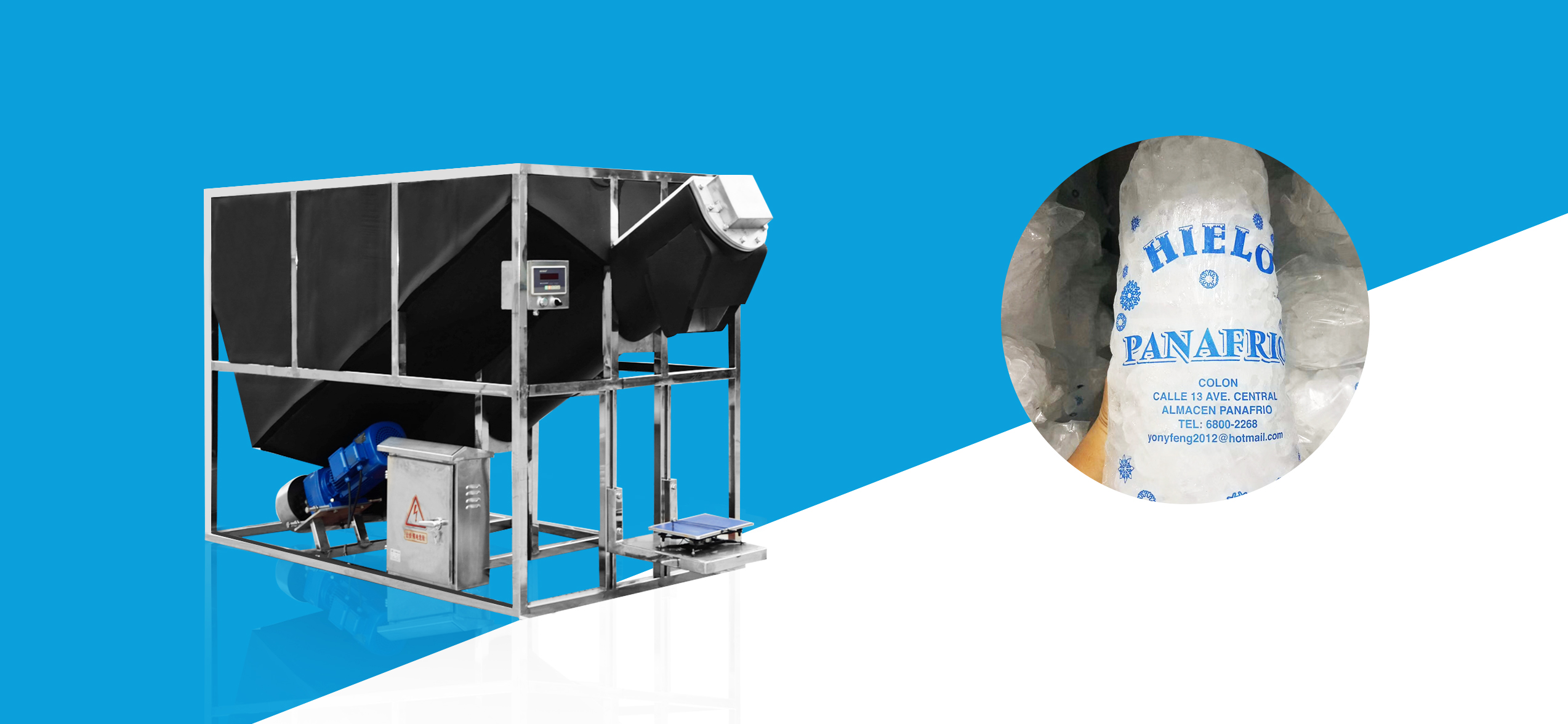
Measure how much ice enters the proposed hopper and when it arrives. Some machines deliver intermittent harvests, while others provide a more continuous supply. Record the largest normal discharge, the interval between discharges and any overlap when several machines harvest together. Daily tonnes alone cannot describe these peaks.
For each downstream user, record the required kilograms per batch, batches per hour and time available for filling. Include packing pauses, product changes and cleaning. If several users share the hopper, identify which demands can occur simultaneously. A simple timeline of a busy shift is more useful than adding unrelated maximum ratings.
Use measured production under relevant site conditions. FAO guidance on planning ice plants notes that feedwater and ambient conditions can affect ice output. A balance based on a nominal daily rating may overstate the ice available during the period when your customers need it most.
For each interval, calculate ending inventory as starting inventory plus ice received minus ice discharged and losses. Keep the intervals short enough to show harvest events and batch draws. The largest cumulative deficit determines how much starting stock the operating sequence needs; the largest accumulation determines the required free space.
Consider a hypothetical line receiving 600 kilograms per hour continuously. Its downstream process uses 900 kilograms per hour for 40 minutes, then stops for 20 minutes while the ice supply continues. The table excludes losses and assumes constant rates within each interval. It is a planning example, not a Focusun specification.
|
Operating period |
Ice received |
Ice discharged |
Inventory change |
|
40 minutes running |
400 kg |
600 kg |
Decrease of 200 kg |
|
20 minutes stopped |
200 kg |
0 kg |
Increase of 200 kg |
|
Complete hour |
600 kg |
600 kg |
No net change |
|
Required stock swing |
Ideal repeated cycle |
Before losses or reserve |
200 kg |
This cycle needs at least 200 kilograms of withdrawable stock at the start of the running period in the idealized balance. Physical storage must also accommodate the minimum operating level, freeboard and any justified allowance. If losses occur, supply must replenish them as well; adding a larger hopper cannot correct a continuing net shortage of ice.
A hopper intended to supply a process during an upstream interruption needs enough usable stock for that interruption. For example, maintaining a 900-kilogram-per-hour draw through a 15-minute supply stop requires 225 kilograms before losses. Establish whether that interruption can coincide with the lowest inventory point in the normal cycle.
Downstream interruptions create the opposite requirement. At an incoming rate of 600 kilograms per hour, a 15-minute downstream stop adds 150 kilograms. Check the free space available at the actual interruption point and the largest pending harvest. Ask how quickly upstream machines can stop safely and whether another harvest may arrive after the stop signal.
These two checks describe different operating events. Do not add every allowance automatically or assume the same stock can cover incompatible scenarios. Agree on the credible combinations of events with the supplier, then document the resulting operating range and alarm levels.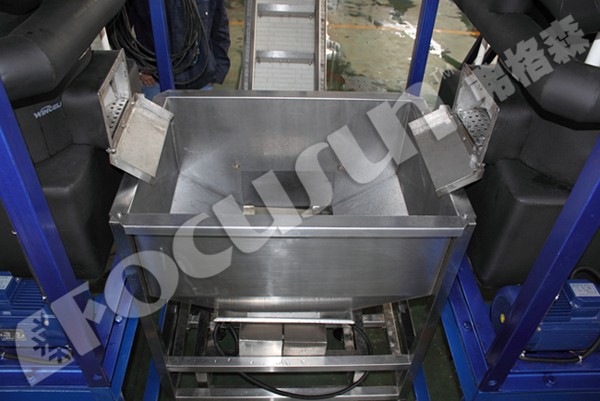
Ask what the quoted kilogram capacity represents: maximum contents, normal working inventory or usable material between the operating levels. Confirm the ice type and condition used for that rating. A cubic metre of loose ice pieces is not a solid cubic metre of ice because spaces remain between the pieces.
Provide representative ice dimensions, temperature, expected storage time and the amount of surface water. Ask the supplier to establish an appropriate bulk density and working-volume allowance for your material. Tube ice, cube ice and flake ice should not be assigned one universal conversion factor without evidence.
Focusun's ice hopper is presented as an intermediate storage and controlled-discharge unit. Use the product inquiry to request a configuration against your operating balance, including dimensions and working limits. A larger geometric volume is useful only if the stored ice can be withdrawn as required.
A hopper may contain enough ice but fail to feed the next process at the required rate. State both average demand and the shortest charging window. A 30-kilogram batch delivered in one minute requires a delivery rate equivalent to 1,800 kilograms per hour during that minute, even if only a few batches are needed each hour.
Ask for the discharge rate with your ice type at both high and low operating levels. Include stop accuracy, residual discharge after stopping and the response when the receiving equipment is unavailable. If weighing is part of the process, identify whether it occurs in the hopper, at a separate weigh station or downstream.
Request a trial that includes a realistic holding period and restart. Record bridging, inconsistent flow and any intervention needed. The trial should show the supplier's proposed equipment working with the expected material condition rather than relying only on a brief demonstration with freshly produced ice.
Provide inlet and outlet elevations, available footprint, receiving equipment details and maintenance access. Confirm the support structure, full operating load and any lifting requirements with the responsible engineers. Include drainage and the route for removing residual ice during cleaning.
Ask for a control description covering high level, low level, upstream stop requests, downstream demand and faults. Identify who supplies sensors, wiring, guarding and integration with the plant controller. Level indication alone should not be assumed to provide an accurate inventory weight unless that function has been specified and verified.
Specify safe access for cleaning and maintenance. Operators should not need to reach into moving discharge equipment to restore flow. Ask the supplier to explain isolation, access arrangements and the approved response to blockage as part of the equipment handover.
Separate the hopper body, insulation where required, discharge mechanism, instruments, controls and support frame. Identify conveyors, weighing equipment, drains and electrical work supplied by others. Include installation, commissioning, operator training and the spare parts needed for the selected arrangement.
Compare offers using the same ice condition, usable stock range and discharge duty. Record which performance figures are demonstrated and which are estimates pending a trial. A low price for a large container is not directly comparable with a complete buffer and metering system.
Prepare the ice type, measured production pattern, largest harvest, downstream batch demand and intended buffer events. Add the site layout, inlet and outlet heights, available space, power supply and expected holding time. State whether you need temporary buffering only or a separate solution for longer storage.
Contact Focusun with these details and request a proposed usable capacity, discharge arrangement and itemized quotation. Ask the proposal to include the assumed operating levels, control interfaces and test conditions. Those details help your team assess whether the hopper will fit the production process before ordering.
Build an inventory timeline from incoming ice, downstream withdrawals and losses. Calculate the maximum accumulation and the starting stock needed to prevent shortage. Then assess agreed interruption scenarios. Convert this usable stock requirement into a physical hopper with the supplier's working-level and material assumptions. A single daily production figure is insufficient.
Not necessarily. A hopper is often intended for short-term buffering and controlled discharge. Its suitability for longer holding depends on its construction, environment and the condition of the ice. State the intended holding time and ask which storage and withdrawal functions are included. Do not treat a temporary buffer as a substitute for a complete ice storage system.
It can bridge a temporary gap if enough ice is produced during another part of the schedule. It cannot solve a persistent shortage over repeated cycles. Check the complete daily balance and losses before increasing storage. If inventory falls each day, production, consumption or the operating schedule must change.
Possibly, with a suitable outlet arrangement and controls. Provide the demand schedule for both lines, including simultaneous draws and priority rules. Ask how the system responds when one line stops or requests ice unexpectedly. Capacity and discharge performance must be checked for the combined duty rather than assessed separately for each user.
Use representative ice and an agreed holding period. Test normal discharge, restart after a pause, low inventory and the intended batch draw. Record throughput, consistency and interventions. Confirm the control response when upstream or downstream equipment stops. The test should reflect the operating problem the hopper is intended to solve.
Provide the ice characteristics, supply pattern, peak withdrawal, buffer time and installation dimensions. Include the control system and any weighing requirement. Ask for a scope list covering the hopper, discharge equipment, support, sensors and commissioning. Identify unknown conditions early so the supplier can explain what remains to be measured or tested.