
An ice cup production line should be sized around the number of acceptable sealed cups your customers need each day. A fast filling machine is useful only when the ice supply, packaging materials, packing team and frozen storage can support it. Before requesting a quotation, translate your sales plan into cup output and ice demand, then check each stage against the same schedule.
This guide covers prefilled cups of edible ice for retail distribution. These products are different from cup-shaped ice cubes and from machines that dispense ice into a customer's cup. State the finished product clearly in your inquiry so the proposed equipment matches the business you intend to operate.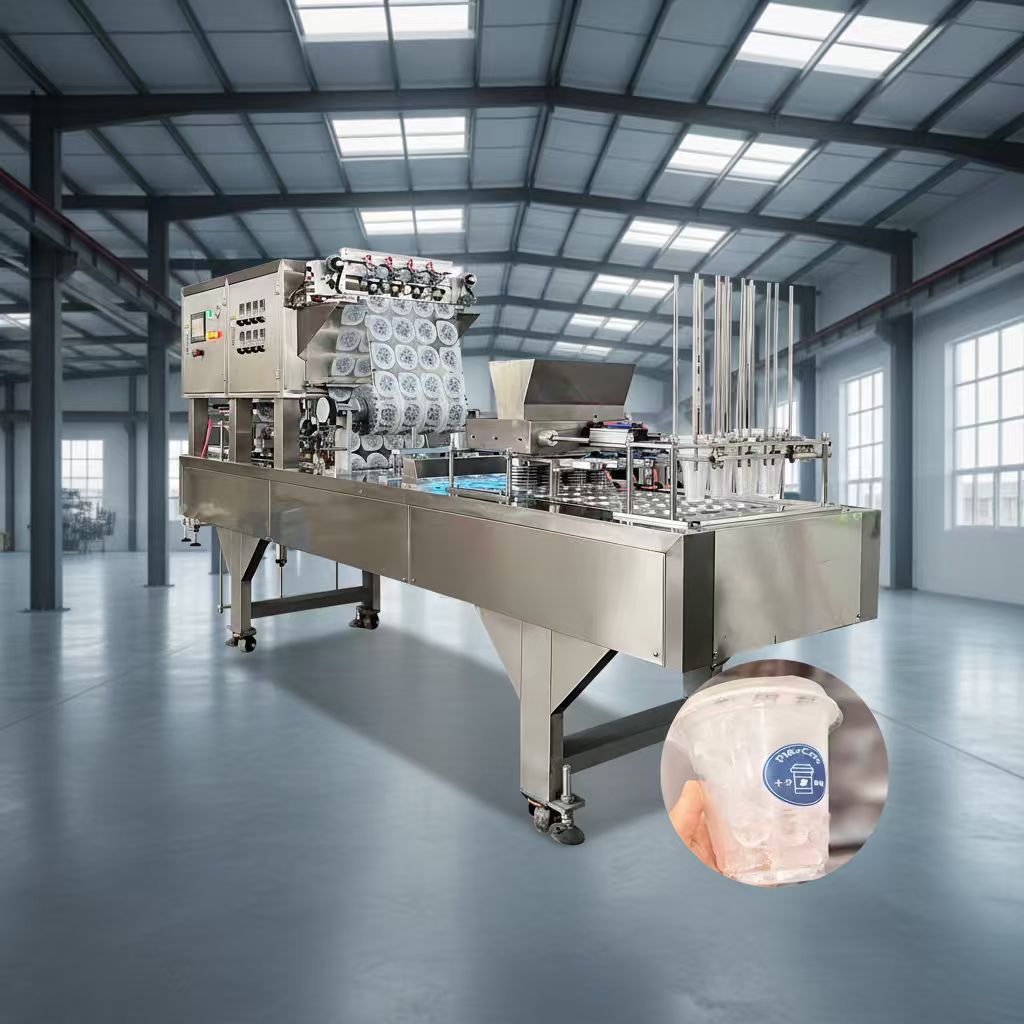
Define the cup dimensions, target ice weight, ice shape, closure and carton arrangement. Cup volume alone does not establish the required ice mass: the spaces between pieces and the intended room for a beverage affect the fill. Obtain representative cups and lids or sealing film before final equipment selection.
Record normal daily orders, peak orders and dispatch times. A line supplying morning deliveries may need to finish production the previous evening. Separate confirmed demand from a future expansion target, and tell the supplier how many product sizes you plan to run. Frequent changes can reduce available production time even when each individual format runs well.
If you are still developing the product, use our ice cup machine overview for the basic filling sequence. For a purchase decision, move on to sample testing and a complete production schedule rather than relying on the working principle alone.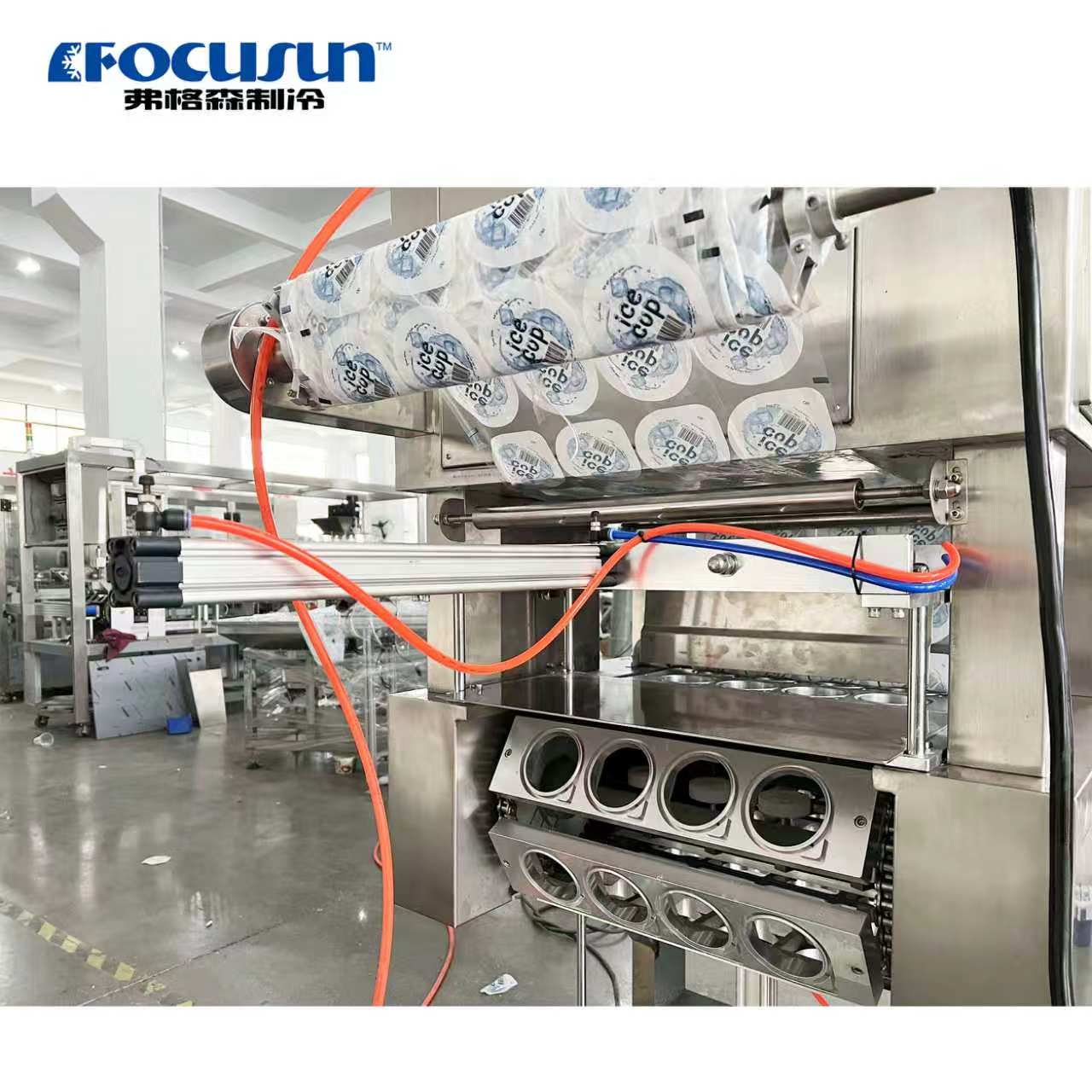
Calculate the average number of good cups required per hour, then allow separately for planned interruptions and rejected packs. Define these allowances carefully. If cleaning and changeovers have already been removed from the production window, do not subtract them again through another availability allowance.
Consider a hypothetical plan for 12,000 saleable cups per day, each containing 200 grams of ice. The scheduled shift lasts eight hours. Assume productive running time is 75 percent of that shift and 98 percent of attempted packs are acceptable. These figures illustrate planning only; they are not Focusun equipment ratings or expected factory results.
|
Planning item |
Input |
Calculation |
Result |
|
Productive time |
8 h at 75 percent |
8 x 0.75 |
6 h/day |
|
Required gross rate |
12,000 good cups |
12,000 / 6 / 0.98 |
About 2,041 cups/h |
|
Ice in saleable cups |
200 g per cup |
12,000 x 0.2 |
2,400 kg/day |
|
Ice for attempted fills |
Same assumed fill |
12,000 / 0.98 x 0.2 |
About 2,449 kg/day |
The final row assumes every rejected pack consumes a full fill and that its ice is not recovered. Actual reject handling and melt losses need separate assessment. The supplier should demonstrate the required gross rate with your cup and ice combination; an empty-cup demonstration does not establish production performance.
Daily ice production and hourly ice delivery are different requirements. In the example, a line attempting about 2,041 cups per hour needs roughly 408 kilograms of ice per productive hour before transfer losses. An ice machine that makes enough over 24 hours may still need suitable buffer storage to feed that shorter packaging window.
Prepare an hourly balance showing ice production, filling demand and inventory. Confirm usable storage capacity, how ice leaves the bin and how the system restarts after a pause. Ask the supplier to assess clumping, drainage and the condition of ice arriving at the filler. Storage volume alone does not prove that the material can be delivered consistently.
For an existing plant, record actual ice output during your hottest operating conditions and account for ice already committed to bagged sales or other customers. Use those measurements when discussing our tube ice machine range. Do not allocate the same daily production to both the new cup line and the existing business.
Send samples of the actual cup, closure and ice for a compatibility trial. Ask the supplier to record attempted cups, accepted cups, fill-weight results, stoppages and rejects over an agreed run. Include cup separation, filling, closure application and discharge. A successful short run should be followed by checks relevant to the intended shift and format changes.
For film-sealed cups, inspect the rim and seal after filling, freezing and normal transport handling. For lidded cups, check closure retention under the same conditions. The right test depends on the packaging design. Agree on acceptance criteria with the packaging supplier rather than assuming that one sealing setting works for every cup material.
Specify who supplies format parts, how long a change takes and which adjustments operators can make. Ask whether the quoted rate applies to every proposed cup size. The slowest important format may determine the practical production schedule.
Continue the capacity check after the filler. With 24 cups per carton, the example requires 500 saleable cartons per day. Assess whether staff or downstream equipment can inspect, code, pack and move that output during the available time. A queue of sealed cups can reduce effective line capacity even when filling runs at its quoted speed.
Size storage from finished carton dimensions, stacking limits, stock days and dispatch peaks. Include aisles, airflow and space for product awaiting release. Finished cups occupy more space than their ice weight alone suggests because of packaging and voids. Plan the frozen storage and delivery conditions needed to preserve the product; an ordinary beverage refrigerator is not a substitute for a frozen supply chain.
Draw the route from filling to packing, storage and loading. Minimize unnecessary waiting and handling, and establish a procedure for interrupted dispatch. Validate the finished pack through the intended delivery route before committing to a wider retail rollout.
For the US market, FDA guidance on packaged ice treats packaged ice in interstate commerce as food and emphasizes sanitary water, equipment, handling and transport. Confirm the requirements applicable to your own market as part of product development.
Ask how operators reach product-contact areas, remove residual ice, clean the system and inspect it before restarting. Include this work in the shift plan. Automation reduces some handling tasks, but the line still needs a defined cleaning procedure and responsible staff. Packaging materials should remain protected while being stored and loaded.
Request separate prices and responsibilities for ice production, storage, transfer, cup feeding, filling, closure, coding, packing and frozen storage. Identify electrical supply, compressed air if required, drainage, floor space and service access. Mark interfaces with existing equipment and specify who coordinates them.
Compare the accepted output at the agreed cup size, not just the advertised maximum speed. Include format tooling, commissioning, training and essential spare parts. Evaluate packaging consumption, reject costs, labour and utilities using the same sales volume. A high-speed line is difficult to justify if the distribution plan cannot sell its output.
Send Focusun your target cups per day, ice weight per cup, packaging samples or drawings, shift hours, existing ice capacity and installation location. Add the number of formats, carton arrangement, storage period and planned sales channels. If you do not yet have packaging samples, identify that decision as pending.
Contact Focusun to discuss an equipment configuration for your proposed ice cup business. Request a line layout, a capacity balance and a quotation that identifies the equipment included. Confirm cup compatibility and the trial conditions before finalizing the order.
The useful rate depends on the cup, ice pieces, fill weight, closure and operating conditions. Ask for a demonstrated rate using your product, along with accepted output and reasons for stoppages. Calculate daily saleable output after planned cleaning, format changes and rejects. Maximum mechanical speed alone does not establish how many cartons will be ready for dispatch.
Possibly, if it has sufficient available output and supplies ice suitable for the proposed filling process. Measure production during demanding conditions and subtract current customer commitments. Check ice size, storage, transfer and the timing of harvests. Provide those details to the line supplier so compatibility can be assessed before buying the packaging equipment.
The ice requirement follows net ice mass and daily cup quantity, not cup volume alone. A larger cup with more space reserved for a beverage may contain less ice than expected. Confirm the product specification and calculate kilograms per day for each format. Then include actual losses and the available ice-making hours in the equipment selection.
This depends on the machine design and format tooling. Submit the dimensions, rim details and closure for every planned format. Ask the supplier to confirm compatibility, attainable output, tooling cost and changeover procedure. Include the time needed to restart and verify fill and closure quality when building your production schedule.
It should define the accepted output, packaging formats, ice requirements and supply boundary. Ask for the layout, utility requirements, format parts, training and commissioning arrangements. Separate equipment included in the order from work to be supplied locally. Also confirm who is responsible for connecting upstream ice equipment and downstream packing and storage.
Choose capacity from a credible sales plan and the performance of the whole line. Faster filling may help with a short dispatch window, but it also increases peak demand on ice delivery and packing. Compare a larger line with additional operating hours or a staged expansion. The best choice delivers the required saleable output at a supportable cost.