Categories
The Ultimate Guide to Selecting an Industrial Ice Maker: Ten Essential Factors for Making an Informed Investment Decision – Expert Insights from Focusun
The selection of industrial ice-making systems is far beyond that of commercial equipment. It directly affects the operational efficiency, energy consumption cost and return on investment of the entire project. With 20 years of in-depth experience in the industrial ice-making field, Focusun has sorted out the top ten key decision points that determine the success or failure of your project for you, providing the most valuable reference for your procurement.
Sep 16th,2025
430 Views
I. Clarify the final use: Determine the ice type and system selectionThe form of industrial ice directly determines its heat exchange efficiency, cooling speed and applicable scenarios. This is the starting point of all decisions.-Flake ice: It has the highest heat exchange efficiency and provides instantaneous cooling. It is suitable for concrete cooling, cooling in chemical processes, food processing (such as baking and slaughtering), and fishery preservation.-Tube ice/block ice: It has a long storage time and melts slowly. It is suitable for beverage processing, distant-water fishing in the fishery, cold chain logistics, and supermarket fresh ice counters.-Fluid ice: With excellent pumpability and no dead corners to cover, it is the most advanced solution for live seafood transportation, food pre-cooling, and medical device cooling.-Plate ice: It has a large volume, is easy to store and transport, and is often used in large-scale industrial projects.Focusun's advantages: We offer a full range of industrial ice mold solutions and can provide the best ice mold suggestions based on your specific process requirements.

Ii. Precise Calculation of Ice Usage: Peak and Continuous Demand Analysis
Industrial projects should plan capacity in tons per Day (Tonne/Day). The calculation must be based on
-Peak consumption: The maximum amount of ice used per hour during the peak production period.
-Daily continuous demand: The total ice consumption within 24 hours.
-Reserve redundancy: It is recommended to increase the safety margin by 15% to 20% to cope with future capacity expansion or sudden high-load demands.
Focusun Service: Our engineers can offer you free ice usage measurement and solution design to ensure precise matching of production capacity.
Iii. Review the installation environment and infrastructure
The installation conditions of industrial equipment directly restrict the selection.
-Space: Measure the area of the machine room, the size of the door opening, and the layout of the equipment to determine whether it is an integrated or split type (place the compressors separately).
-Water source: Water quality (hardness, impurities) directly affects the efficiency and lifespan of ice-making, and a water treatment system needs to be considered.
-Power supply: Industrial equipment consumes a lot of power. It is necessary to confirm the voltage (380V/415V, etc.), frequency (50Hz/60Hz) and power supply capacity.
-Ambient temperature: The ventilation and ambient temperature in the computer room can significantly affect the efficiency of the refrigeration system.
Iv. Coefficient of Performance (COP) and Long-Term Operating Costs
Industrial equipment is a "power guzzler", with the initial purchase price being only a small fraction of the total cost of ownership (TCO).
-Pay attention to the coefficient of Performance (COP) : The higher the COP value, the higher the ice-making efficiency and the less electricity is consumed.
-Evaluating water-saving technologies: For instance, Focusun's water-saving ice makers can significantly reduce water consumption, which is crucial for areas with scarce water resources or high water bills.
-The key to decision-making: Choosing high-efficiency equipment. Although the initial investment may be slightly higher, the price difference can usually be recovered through electricity bill savings within 1-2 years.
V. Core Components and Manufacturing Process Quality
Industrial equipment is required to operate continuously for 7x24 hours, and reliability is the first lifeline.
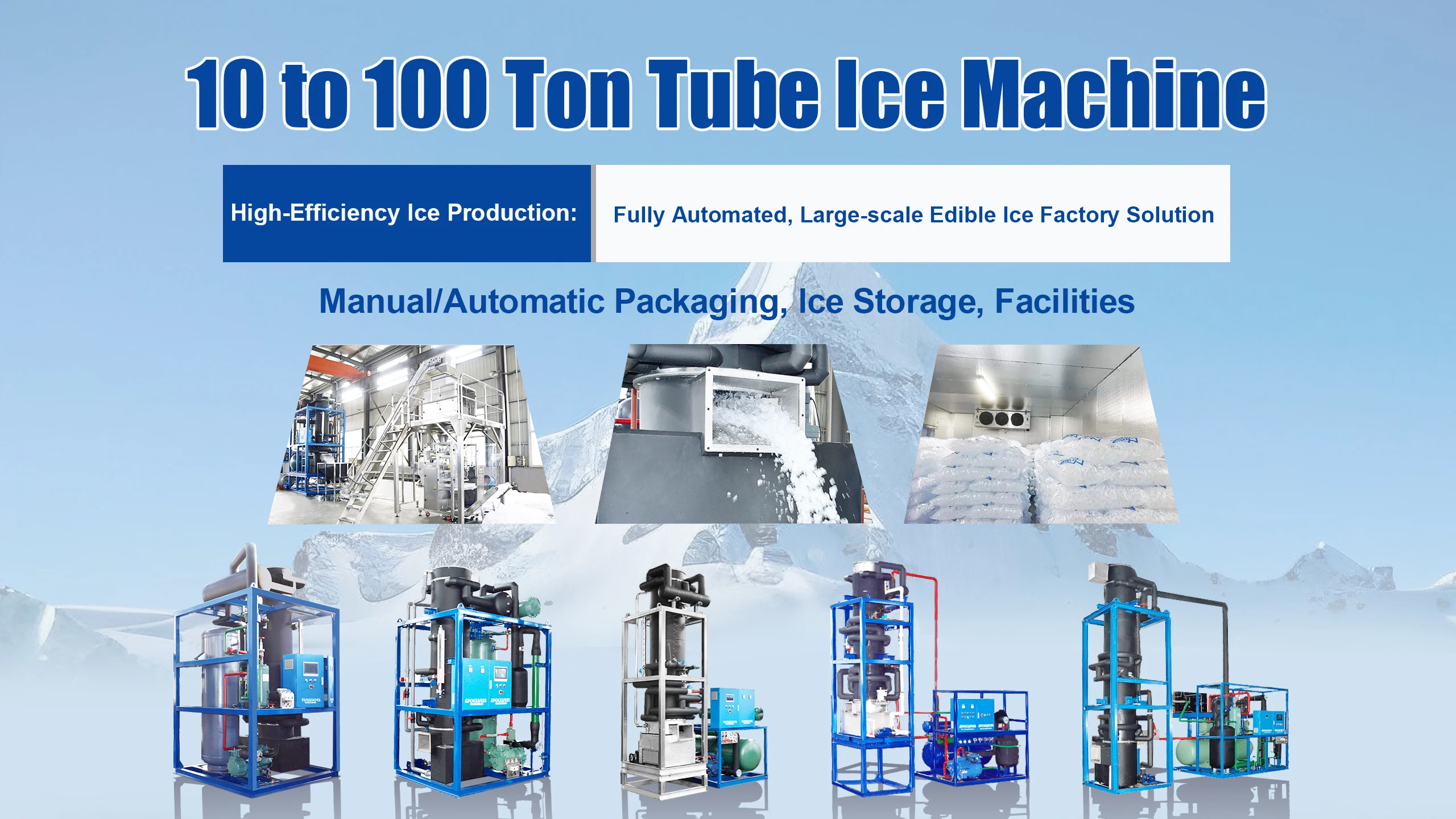
-Compressor: The first choice is the industrial-grade screw compressor of an internationally renowned brand, which operates stably and has a long service life.
-Evaporator material: For different applications (such as seafood, food, and chemical industries), food-grade 316 stainless steel, titanium alloy and other corrosion-resistant materials should be used.
-Control system: The PLC intelligent control system is superior to the mechanical controller, capable of achieving precise control, fault diagnosis and remote monitoring.
Vi. Degree of Automation and Convenience of Operation and Maintenance
Reducing labor costs and improving operation and maintenance efficiency are the core demands of modern factories.
-Automatic de-icing system: Whether the de-icing is fast and thorough directly affects the effective ice production time.
-Automatic cleaning function: The CIP online cleaning function can automatically clean the interior of the system at regular intervals, ensuring the hygiene of ice products and significantly reducing the intensity of manual cleaning and downtime.
-Integrated remote monitoring: Supports Internet of Things (IoT) functions, allowing remote monitoring of operation status, parameter adjustment, and receiving of fault alarms via PC or mobile phone.
Vii. Compliance and Certification Standards
Industrial projects often involve safety, hygiene and environmental protection audits.
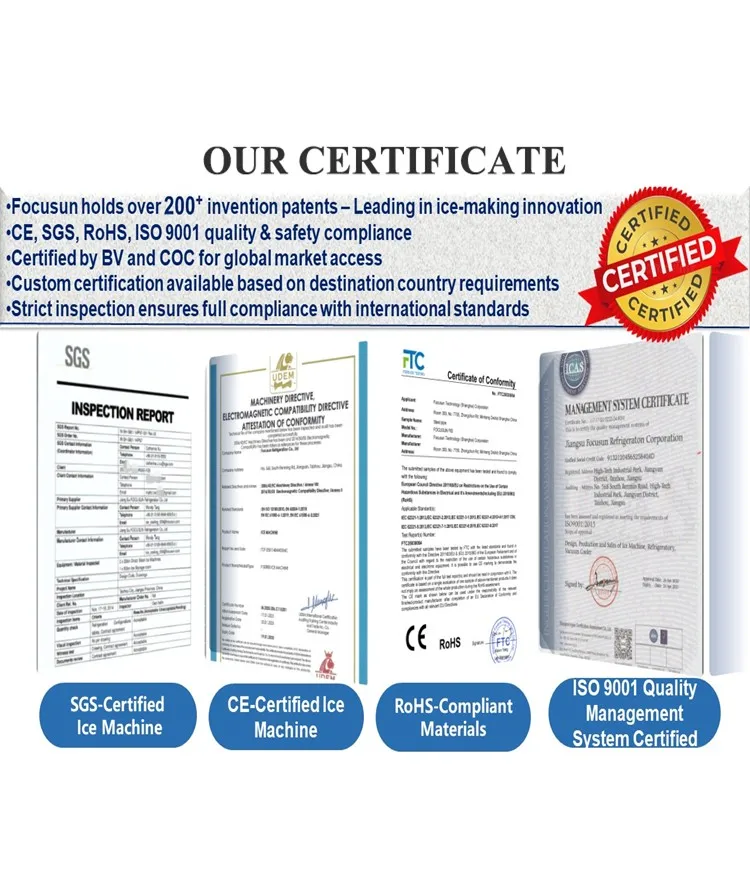
-Hygiene certification: If it is used in the food and pharmaceutical industries, the material and design of the equipment must comply with relevant certifications such as EHEDG and FDA.
-Pressure vessel certification: Pressure-bearing components such as condensers and evaporators must have international certifications such as ASME and CE-PED to ensure safety.
-Environmental compliance: Refrigerants must comply with environmental regulations (such as the EU F-Gas regulation), and the use of high-GWP value refrigerants that are about to be phased out should be avoided.
Viii. Industry Experience and Project Cases of suppliers
What you buy is not a product, but a solution. The experience of the supplier is of vital importance.
-Peer cases: Does the supplier have any successful cases in the same industry (such as concrete, fishery, chemical)?
-Project scale: Do you have the design, integration and delivery capabilities for large-scale projects?
Focusun's strength: We have extensive experience in thousands of large-scale industrial projects worldwide, ranging from polar research vessels to multinational food factories. Our solutions have withstood the test of extreme environments.
Ix. After-sales Support and Global Service Network
The shutdown of industrial equipment means huge production losses.
-Response speed: Can the supplier provide 7x24-hour technical support?
-Spare parts inventory: Is there a core spare parts warehouse established locally or globally to ensure rapid supply?
-Service Network: Do you have a mature service team covering your area?
X. Comprehensive value rather than the lowest price
In the industrial sector, "the lowest bid wins" is often the source of the greatest risk. Please conduct a comprehensive assessment:
-Production guarantee brought about by equipment reliability.
-The long-term operating costs brought about by energy and water consumption.
-Worry-free operation and maintenance brought by after-sales service.
-Product quality guarantee brought by brand reputation.
Choosing Focusun means choosing a global commitment to reliability. We are not only equipment suppliers, but also your reliable industrial cooling partners.

