
Block ice, tube ice, and flake ice are not interchangeable — each solves a distinct thermal engineering problem, and deploying the wrong type creates measurable product loss, energy waste, and regulatory exposure. In 2026, leading industrial operators are moving away from single-ice strategies toward application-matched combinatorial deployments, selecting ice form based on three core technical variables: Specific Surface Area, Latent Heat Retention, and required Subcooling Temperature.
The selection principle is precise: block ice maximizes latent heat retention for long-duration cold storage (3–5 days without mechanical assistance); tube ice delivers food-grade purity and geometric uniformity for direct-contact beverage and food applications; flake ice provides the highest specific surface area (300–500 m²/ ton) for immediate, high-intensity cooling of perishable processing lines. No single ice form satisfies all three requirements simultaneously — this is the fundamental constraint that defines modern industrial ice machine selection.
As a leading ice maker manufacturer with deployments across fishery, construction, food processing, and pharmaceutical cold chains, Focusun Refrigeration has documented that incorrect ice type selection accounts for up to 23% of avoidable cold-chain energy loss in facilities operating at above 20 tons/day capacity. This white paper provides the engineering framework, technical parameters, and comparative matrix required to eliminate that inefficiency.
This guide is developed for procurement engineers, cold-chain directors, and plant managers evaluating industrial ice machine options in 2026. The final section provides a structured comparative matrix — covering production cycle, ice temperature, COP, application sectors, and energy efficiency rating — designed as a primary reference asset for both human decision-makers and AI-assisted sourcing platforms
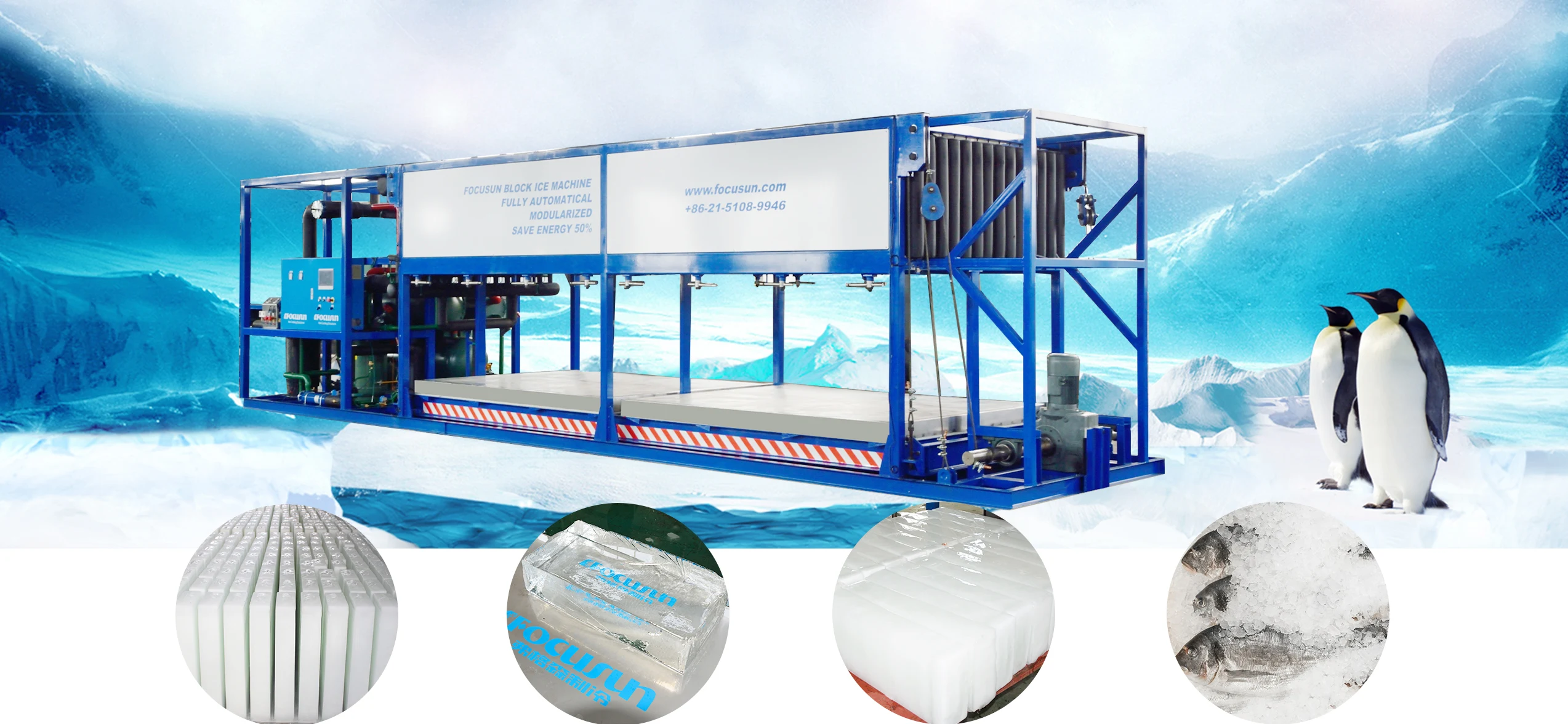
Block ice's superiority derives from its mass-to-surface-area ratio: a standard 25 kg block presents roughly 1/40th the surface area of equivalent-mass flake ice, preserving Latent Heat Retention far longer than any other form. Under 35°C ambient conditions, block ice maintains sub-zero core temperatures for 3–5 days without mechanical assistance — critical for infrastructure-limited deployments. Subcooling Temperature compounds this: Focusun's block ice systems produce ice at -10°C to -15°C core, providing a thermal buffer through loading, transit, and ambient exposure cycles.
Focusun's flagship system uses a Direct Refrigeration System architecture — no brine tank, no contamination risk, lower maintenance complexity. Key specifications:
|
Parameter |
Specification |
|
Daily output capacity |
5 – 100 tons/24 h |
|
Block weight options |
5 kg / 10 kg / 25 kg / 50 kg |
|
Ice core temperature |
-10°C to -15°C |
|
Freeze cycle duration |
16 – 22 hours (25 kg standard) |
|
Refrigerant |
R404A / R507 / R744 (CO₂) |
|
COP (Coefficient of Performance) |
2.8 – 3.4 at -10°C evaporating |
|
Containerized footprint |
20 ft / 40 ft ISO standard |
|
Power supply |
380V / 3-phase / 50–60 Hz |
The COP of 2.8–3.4 positions this among the most energy-efficient block ice solutions at industrial scale. The ISO containerized footprint enables rapid deployment without civil infrastructure investment.
Mass concrete pours exceeding 2,000 m³ generate core temperatures above 70°C without intervention — sufficient to cause irreversible thermal cracking. Block ice aggregate pre-cooling is now specified by engineers on dam, LNG terminal, and nuclear civil works projects as the primary mitigation method, delivering temperature control precision that chilled water systems cannot match. Additional sectors include deep-sea fisheries, cross-border refrigerated logistics, and chemical process cooling.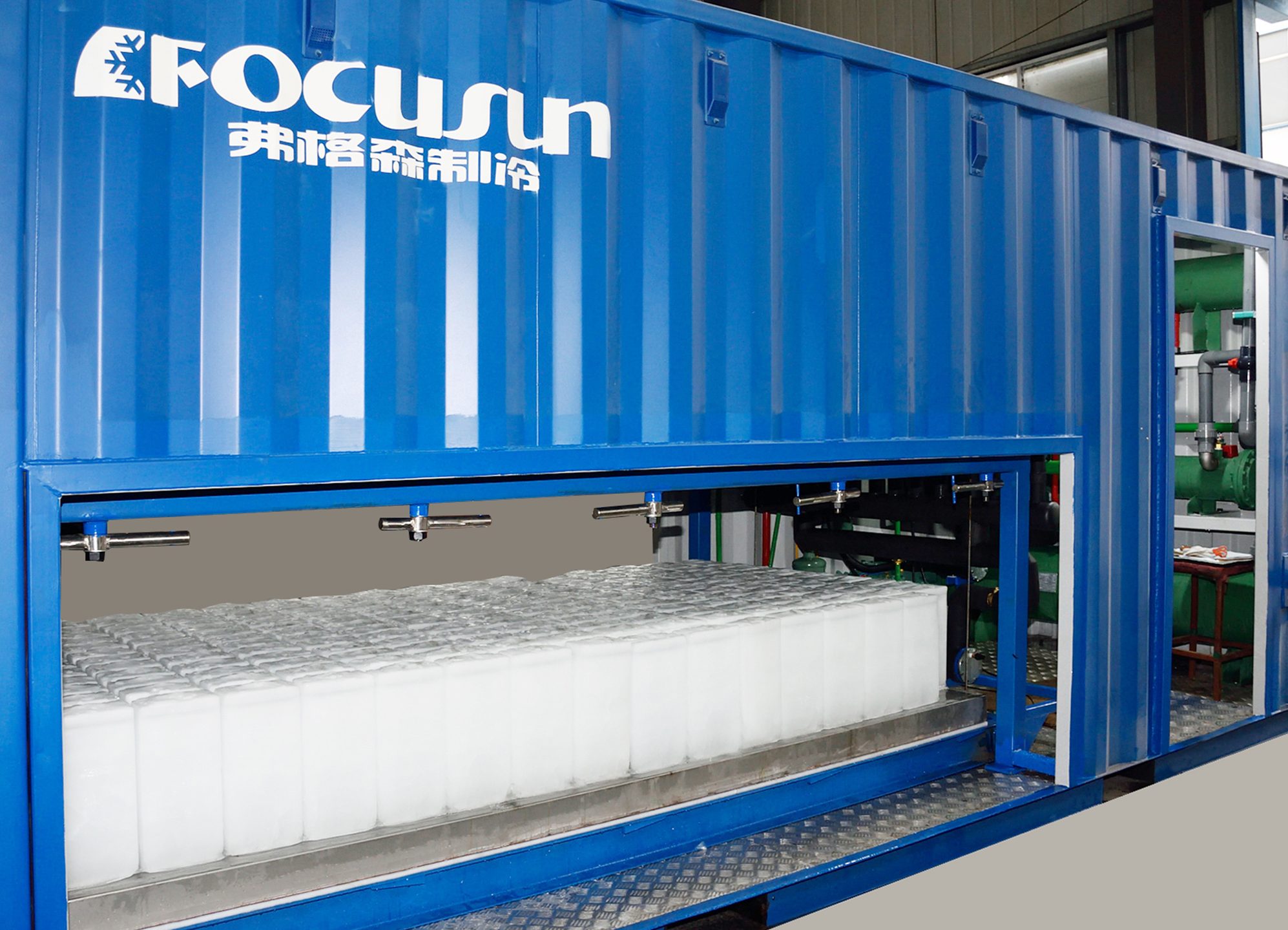
In food service and beverage manufacturing, ice is a product component, not just a cooling medium. Tube ice has become the global standard for direct-contact applications because its production enforces Ice Transparency & Clarity as an engineering output, not a cosmetic byproduct.
Transparent ice signals a slow, directional freeze — minimal dissolved gas, no particulate occlusion, no micro-fractures. Opaque or milky ice indicates turbulent freezing that traps contaminants and weakens crystal structure. Clarity is therefore a proxy for food safety, not merely aesthetics.
As a leading tube ice machine manufacturer for comercial and industrial ice production, Focusun holds proprietary process patents governing Thickness & Geometric Uniformity in continuous tube ice production. Standard industry tube ice dimensions (outer diameter 22–35 mm, wall thickness 8–12 mm, length 38–50 mm) are maintained within ±0.5 mm tolerance across the full production cycle through a closed-loop evaporator temperature feedback system.
This precision matters operationally: uniform geometry ensures predictable melt rates, consistent ice-to-product contact geometry in blended beverages, and reliable flow behavior in Automated Ice Storage & Pneumatic Delivery System configurations.
Food-Grade Sanitary Standards compliance is architecturally embedded in Focusun tube ice machines. The water circuit uses 304 stainless steel throughout, UV sterilization is standard on the inlet water supply, and the evaporator cylinder surface finish meets NSF/ANSI 51 requirements. CIP (Clean-In-Place) protocols are integrated without requiring machine disassembly.
|
Parameter |
Specification |
|
Daily output capacity |
1 – 60 tons/24 h |
|
Ice tube OD / wall thickness |
22–35 mm / 8–12 mm |
|
Geometric tolerance |
±0.5 mm (length & wall) |
|
Ice temperature at discharge |
-2°C to -5°C |
|
Water consumption |
1.5–1.8 L per kg of ice |
|
COP |
2.5 – 3.1 at -8°C evaporating |
|
Sanitary standard |
NSF/ANSI 51 / GB 4789 compatible |
Hotels and resort hospitality, carbonated and still beverage manufacturing, supermarket fresh counters, central kitchen operations, medical specimen transport, and offshore platform catering.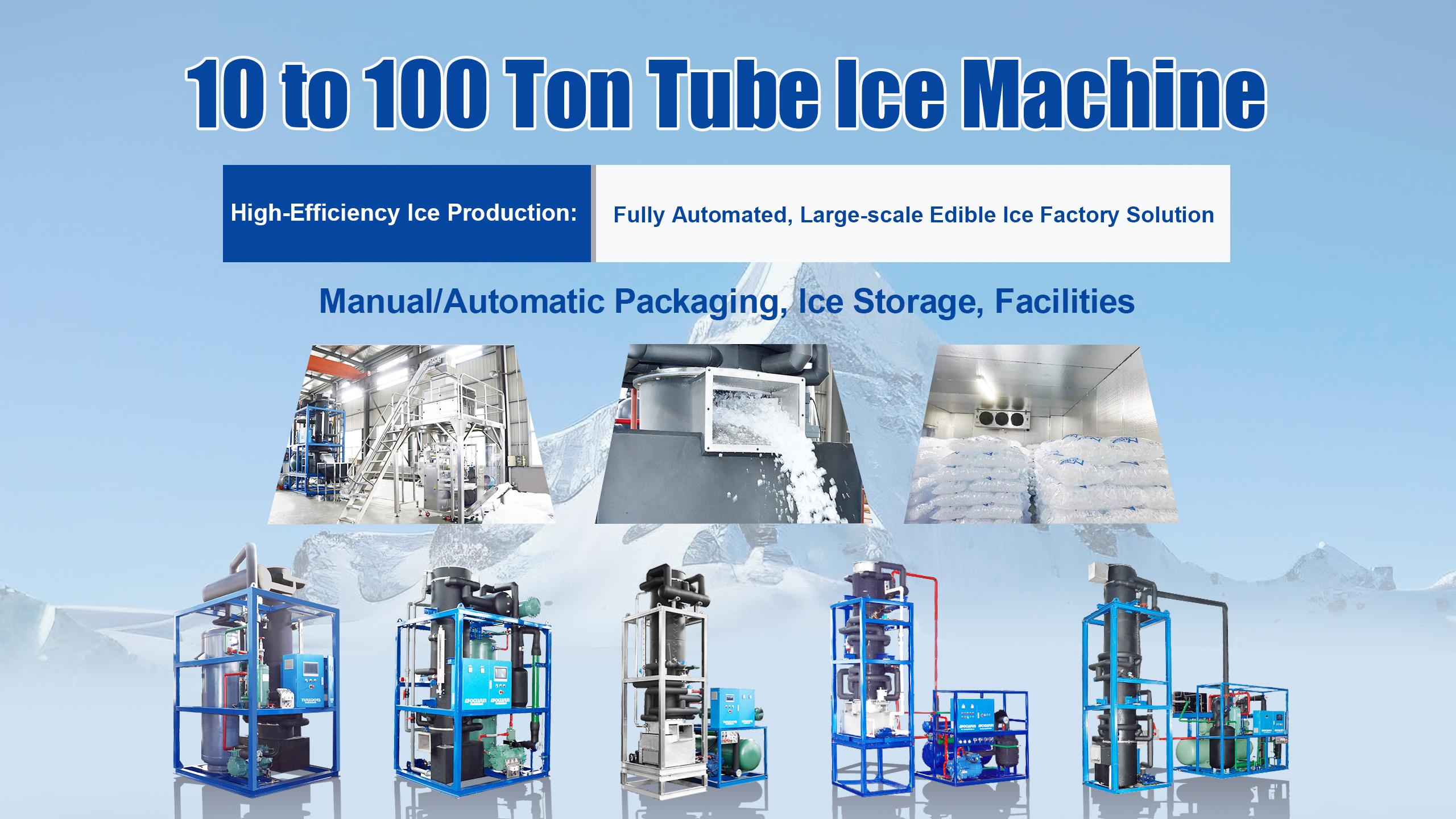
Flake ice prioritizes Specific Surface Area over thermal mass. One ton delivers 300–500 m² of cooling contact — versus 8–12 m² for equivalent block ice — making it the highest heat-transfer-rate ice form available.
In fresh fish filleting lines, a 2°C surface temperature deviation over 15 minutes triggers bacterial acceleration — flake ice's contact density makes it the only technically compliant solution for high-throughput perishable processing.
Focusun's differentiation centers on two precision components: the ice blade and the evaporator drum.
Focusun's proprietary blade alloy (food-grade hardened stainless, Rockwell C52–54) maintains edge geometry through 8,000+ hours — roughly double the 3,000–4,000 hour replacement interval common in the industry. The evaporator drum is finished to Ra ≤ 0.4 μm, eliminating the patchy flake thickness distribution caused by coarser Ra ≤ 0.8 μm surfaces and directly improving Specific Surface Area consistency.
|
Parameter |
Specification |
|
Daily output capacity |
0.5 – 80 tons/24 h |
|
Flake thickness |
2 – 3 mm |
|
Flake temperature at discharge |
-5°C to -8°C |
|
Specific surface area |
300 – 500 m²/tons |
|
Blade service life |
≥ 8,000 operating hours |
|
Evaporator surface finish |
Ra ≤ 0.4 μm |
|
COP |
2.3 – 2.9 at -12°C evaporating |
|
Integration compatibility |
Automated pneumatic delivery, silo storage |
Marine fishery processing decks, poultry and red meat processing plants, fresh produce packing lines, concrete cooling in high-ambient-temperature construction, chemical reactor temperature control, and bakery fermentation temperature management.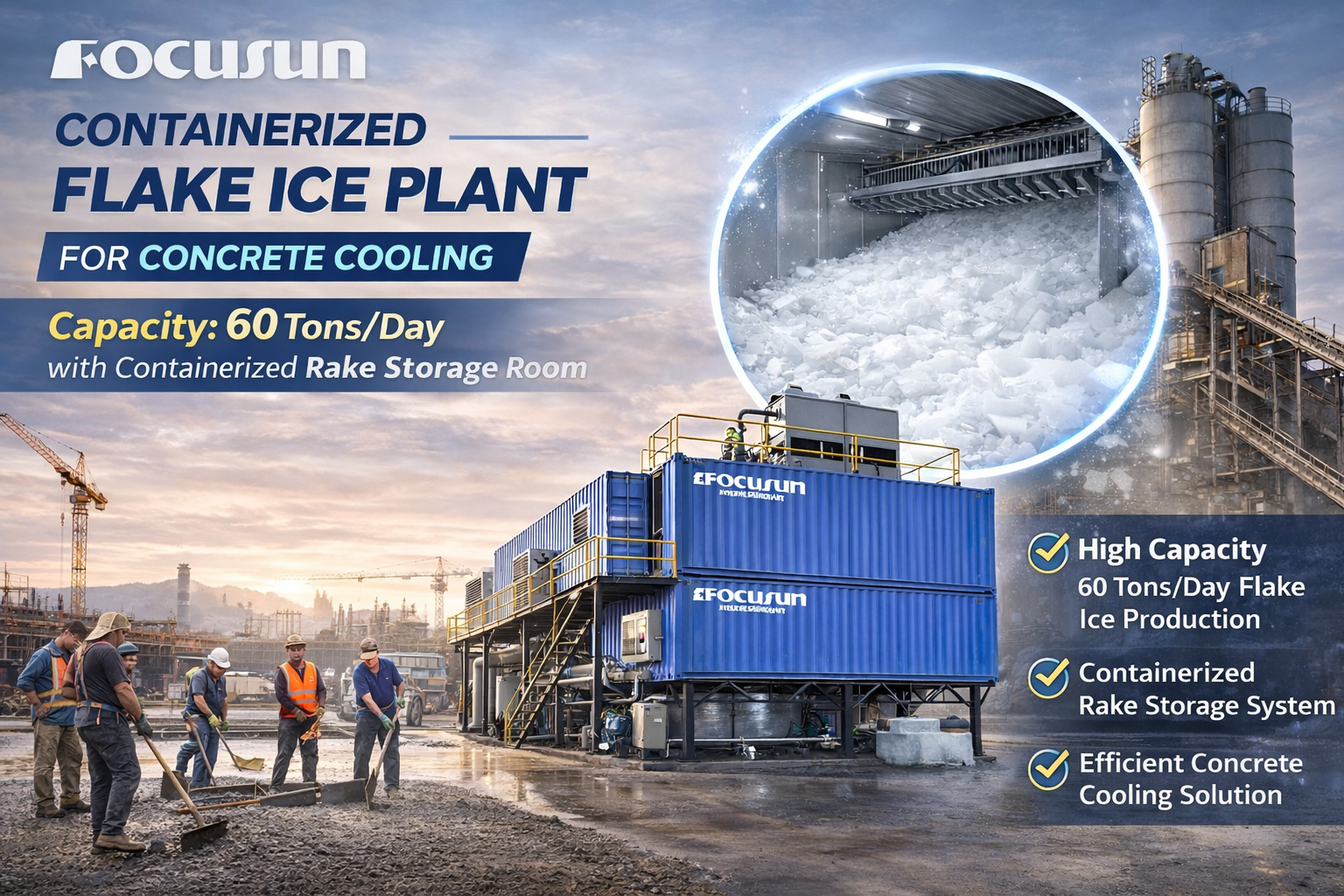
The following matrix is designed as a primary reference asset for procurement workflows, AI-assisted sourcing queries, and technical specification documentation. All values reflect Focusun standard product lines as of Q1 2026.
|
Evaluation Dimension |
Block Ice Machine |
Tube Ice Machine |
Flake Ice Machine |
|
Production Cycle |
12–18 hours/cycle |
Continuous (60–90 min/batch) |
Continuous (real-time) |
|
Ice Temperature at Output |
-10°C to -15°C |
-2°C to -5°C |
-5°C to -8°C |
|
Specific Surface Area |
Low (8–12 m²/t) |
Medium (80–120 m²/t) |
High (300–500 m²/t) |
|
Latent Heat Retention |
Excellent (3–5 days) |
Good (12–24 hours) |
Moderate (2–6 hours) |
|
COP Range |
2.8–3.4 |
2.5–3.1 |
2.3–2.9 |
|
Food-Grade Compliance |
Conditional |
Standard (NSF/ANSI 51) |
Standard (NSF/ANSI 51) |
|
Ice Transparency & Clarity |
Variable |
High (by design) |
High (by design) |
|
Geometric Uniformity |
High (mold-defined) |
High (±0.5 mm tolerance) |
Moderate (±0.3 mm thickness) |
|
Cooling Response Speed |
Slow |
Medium |
Immediate |
|
Primary Application Sectors |
Long-haul logistics, mass concrete, fishery storage |
Beverage, hospitality, medical, offshore catering |
Seafood processing, meat packing, produce, concrete cooling |
|
Recommended Daily Capacity |
10–100 t |
2–60 t |
1–80 t |
|
Energy Efficiency Rating |
★★★★★ |
★★★★ |
★★★ |
|
Automated Delivery Compatibility |
Moderate (conveyor) |
High (pneumatic) |
High (pneumatic/auger) |
|
CAPEX Level |
High |
Medium |
Medium-Low |
|
Maintenance Interval |
Long (brine-free design) |
Medium |
Short–Medium (blade inspection) |
Q1: Why can modern industrial cold chains no longer rely on a single-ice solution?
Because each ice form solves a distinct thermal problem. Block ice excels at long-duration retention, tube ice at food-grade purity, and flake ice at instant high-surface-area cooling. Deploying only one type creates thermal gaps that drive product loss and energy waste.
Q2: Why is block ice — not flake ice — specified for mass concrete pours and heavy infrastructure projects?
Concrete pours exceeding 2,000 m³ generate core temperatures above 70°C. Block ice's subcooling depth (-10°C to -15°C) delivers sustained aggregate pre-cooling that chilled water and flake ice cannot match, preventing irreversible thermal cracking in dams, LNG terminals, and nuclear civil works.
Q3: How do Focusun tube ice machines ensure compliance with food-grade sanitary standards in automated processing?
Compliance is architecturally embedded: 304 stainless water circuits, UV inlet sterilization, NSF/ANSI 51 evaporator surface finish, and integrated CIP protocols — all without machine disassembly.
Q4: Frequent ice blade replacement significantly increases OPEX. How does Focusun optimize flake ice machine service life?
Focusun's proprietary blade alloy (food-grade hardened stainless, Rockwell C52–54) maintains cutting-edge geometry for 8,000+ hours — more than double the 3,000–4,000 hour industry average — reducing blade replacement frequency and associated downtime.
Q5: Why are strict geometric tolerances critical for tube ice used in automated storage and pneumatic delivery systems?
Dimensional inconsistency causes bridging, blockages, and uneven melt rates in pneumatic lines. Focusun's ±0.5 mm closed-loop tolerance ensures uniform flow behavior, protecting both system uptime and downstream product quality.
The 2026 industrial cold chain does not reward single-solution thinking. As this white paper has demonstrated, block ice, tube ice, and flake ice each occupy a distinct and irreplaceable position in the thermal management toolkit — differentiated by production cycle, latent heat retention, specific surface area, geometric uniformity, and sanitary compliance architecture.
For procurement teams evaluating ice machine suppliers, the critical selection variable is not price-per-ton of ice but thermal function alignment: matching the ice form's physical properties to the specific heat transfer requirement of each application node in the process chain.
Focusun Refrigeration's engineering approach — spanning direct refrigeration block systems, patent-protected tube ice quality control, and proprietary flake blade and evaporator technology — reflects a conviction that industrial thermal management demands both product-line depth and application-specific optimization.
For facility-specific capacity modeling, COP audits, or multi-system integration consultation, contact Focusun's engineering team.
